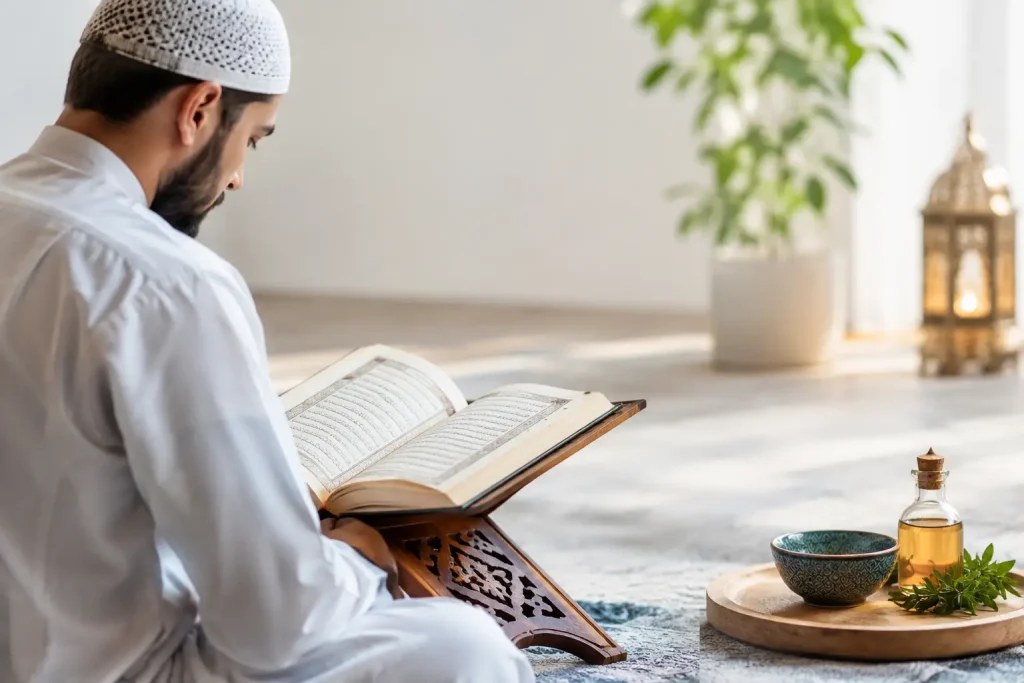
A family may recite Surah al-Baqarah regularly, maintain morning and evening adhkar, and still ask a serious question when distress persists: is this simply Quranic recitation, or is a more targeted ruqyah process needed? The discussion around Quranic recitation versus ruqyah is often confused because the two overlap deeply, yet they are not identical in purpose, structure, or application.
The Qur’an is guidance, mercy and healing by Allah’s permission. Reciting it is an act of worship whether a person feels well, is under pressure, or is seeking protection. Ruqyah, however, is a defined healing and protective practice rooted in recitation, supplication, reliance upon Allah, and the Prophetic framework. Understanding that distinction protects families from two mistakes: reducing ruqyah to merely playing recitation in the background, or treating every hardship as proof of a spiritual diagnosis.
Quranic recitation is worship before it is treatment
A Muslim recites the Qur’an to draw near to Allah, receive guidance, strengthen faith, reflect, correct the heart and seek His mercy. These aims remain true even where there is no illness, no fear of evil eye, and no concern about sihr or al-mass. The value of recitation is not dependent on a visible result or a crisis.
This matters because the Qur’an must never become a tool used only when someone wants an immediate solution. A household that establishes daily recitation, salah, dhikr, du’a and obedience is building spiritual resilience. That foundation is itself a form of protection, but it should not be presented as a mechanical formula or a guarantee that a believer will never face hardship.
Recitation may also bring comfort, steadiness and spiritual benefit to someone with physical or psychological illness. Yet relief after recitation does not, by itself, establish the cause of an illness. A person may feel calmer because the Qur’an settles the heart, because anxiety has reduced, because they are supported by family, or through factors not yet understood. Responsible Islamic practice does not turn every response into a definitive diagnosis.
Quranic recitation versus ruqyah: the practical difference
Ruqyah uses the Qur’an, authentic supplications and permissible words of healing or protection with a directed intention. It is not detached from worship, but it applies worship within a treatment context. The person performing ruqyah is seeking Allah’s cure and protection for a particular concern, whether that concern is known, suspected or simply causing ongoing distress.
The difference is therefore not that recitation is Islamic while ruqyah is somehow separate from Islam. Authentic ruqyah is built upon the same revelation. The difference lies in purpose, focus and method.
A person reading a daily juz is engaging in Quranic worship. A parent reciting al-Fatihah, Ayat al-Kursi, al-Ikhlas, al-Falaq and al-Nas over an unwell child, making relevant prophetic supplications, and asking Allah for protection is conducting ruqyah. Both are valuable. One does not cancel the other.
Classical reports show that ruqyah was practised with Qur’anic recitation and supplication, including recitation over the sick and the use of blowing lightly after reciting. The governing boundary repeatedly emphasised by scholars is freedom from shirk and theological corruption. That principle is more precise than assuming that every unfamiliar method is automatically forbidden, or that every popular practice is automatically sound.
Ruqyah requires more than a recording
Listening to Qur’an is beneficial, and many people find it spiritually strengthening. But passive listening is not always equivalent to an intentional ruqyah session. Ruqyah commonly involves direct recitation, present intention, du’a, attentiveness and, where appropriate, a structured plan over time.
This is not a claim that a person must have a practitioner present for the Qur’an to benefit them. Self-ruqyah is central. The Prophet Muhammad ﷺ taught believers supplications and protective recitations that can be practised independently. In fact, families should not become helplessly dependent on a raqi for every concern. Foundational self-ruqyah knowledge is a practical capability every Muslim household should build.
At the same time, persistent and complex cases may require more disciplined assessment. A trained practitioner should not merely repeat verses loudly or make dramatic claims. They should distinguish what is established by revelation from what is observed in practice, and what remains only a working hypothesis. They should also recognise when medical assessment, mental health support, safeguarding or urgent clinical care is required.
Why intention alone is not enough
It is tempting to say that ruqyah is simply Quranic recitation with intention. Intention is essential, but it does not account for the whole methodology. Effective ruqyah practice also involves correct creed, suitable Qur’anic and Prophetic material, patient observation, consistency, ethics and an awareness of individual circumstances.
For example, a person with recurring panic, insomnia, pain or intrusive thoughts may benefit from a regular self-ruqyah routine. But those experiences can also have medical, psychological, relational, environmental or mixed causes. A practitioner who labels them as sihr, evil eye or possession without sufficient basis has exceeded the evidence. Equally, a clinician or relative who dismisses all spiritual concern without listening may fail to understand the person’s religious framework and lived experience.
The stronger approach is not spiritual reductionism or medical reductionism. It is disciplined care. Seek appropriate medical investigation, continue prescribed treatment unless advised otherwise by a qualified clinician, and establish a sincere ruqyah programme where spiritual protection or healing is sought. There is no contradiction in pursuing both means while knowing that cure belongs to Allah.
What a structured self-ruqyah practice looks like
For most households, the starting point should be simple and consistent rather than dramatic. Maintain the obligatory prayers, establish morning and evening adhkar, recite Qur’an daily, and use the known protective passages and supplications with understanding and presence of heart. When facing a particular concern, set aside a focused time for direct recitation and du’a rather than relying only on intermittent background audio.
Keep a measured record of what is happening. Note symptoms, sleep, mood, physical triggers, medication changes, major stresses and responses to treatment. This does not turn ruqyah into a laboratory experiment, nor does it deny the unseen. It helps prevent loose assumptions. Patterns can be useful observations, but an observation is not yet proof of a spiritual cause.
If water is recited over and used within a ruqyah routine, the person should understand the evidential basis being relied upon and avoid attaching independent power to any object or method. The recitation, supplication and healing are sought from Allah alone. In more advanced practice, methods must be assessed by their theological boundaries, the evidence available, their safety, consent and the claims made for them.
Where Higher Ruqyah needs intellectual discipline
Some practitioners explore structured approaches beyond basic repetition, including treatment sequences, environmental considerations and methodologies developed through sustained case observation. Such work may offer useful hypotheses, but it must be discussed with intellectual honesty.
At the International Academy of Ruqyah, the aim is not to confuse novelty with proof, nor to reject a method merely because it is unfamiliar. A serious methodology asks four questions: does it preserve tawhid and avoid shirk; is it consistent with Islamic legal and ethical limits; what is the quality of its evidence; and are its outcomes being described as observation, inference or established conclusion?
That framework matters because ruqyah can become distorted from both directions. One direction freezes the field into unexamined habits. The other makes expansive claims on the basis of limited experiences. Neither serves sufferers well. Responsible development requires Qur’an-and-Sunnah grounding, scholarly awareness, clinical caution and honest practitioner reflection.
When to seek further help
If symptoms are severe, escalating or affecting safety, seek urgent medical or mental health support without delay. If a person is experiencing persistent distress, unexplained physical symptoms, recurring family concern or a prolonged sense that standard approaches have not addressed the full picture, a structured ruqyah consultation may be appropriate alongside healthcare.
Choose support carefully. A trustworthy practitioner will not promise a cure, claim certainty without evidence, pressure you into abandoning treatment, or turn vulnerability into dependency. They should explain what they are doing, respect privacy and consent, and be able to distinguish a faith-based treatment process from a definitive claim about unseen causes.
Begin with what is in your hands: recite the Qur’an with regularity, pray with attentiveness, learn the Prophetic protections, and ask Allah directly for healing. If the concern remains, seek knowledgeable support that takes both revelation and the complexity of human illness seriously.