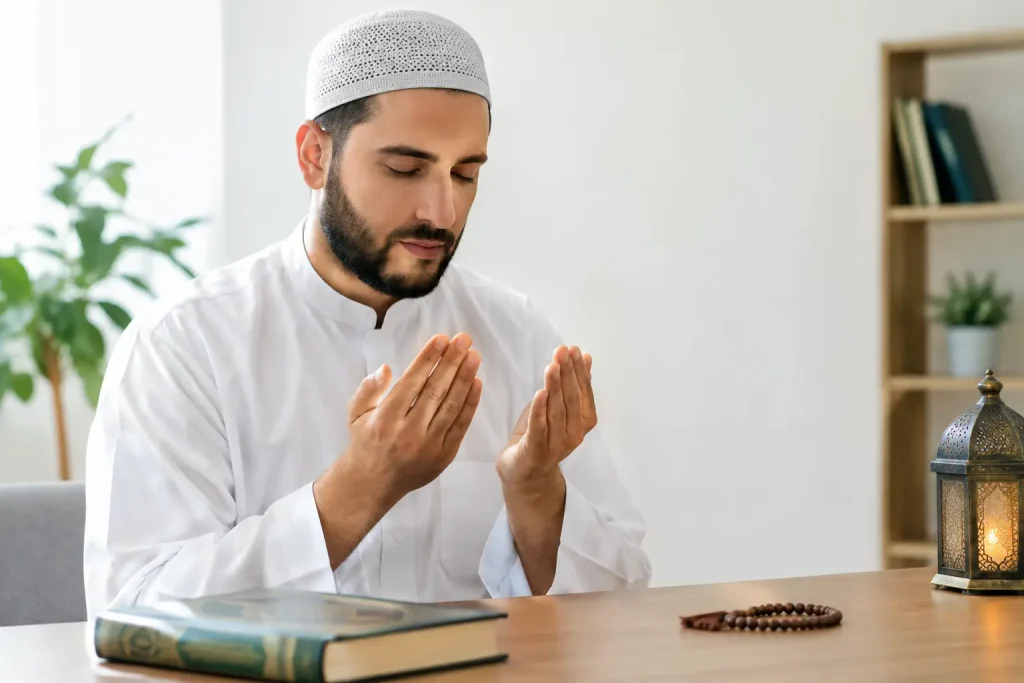
A person may have completed months of ordinary ruqyah recitation, sought medical support, improved some areas of life, and still face a pattern that requires closer assessment. Understanding higher ruqyah methods begins here: not with a claim that every difficult case has a hidden spiritual cause, but with the recognition that ruqyah can require greater structure, sharper observation, and more disciplined application than repetition alone.
Higher Ruqyah is not a licence for spectacle, unsupported certainty, or techniques detached from tawhid. It is an advanced methodological field: the careful development of treatment approaches within Islamic boundaries, informed by Qur’an, Sunnah, scholarly principles, practitioner observation, and responsible reasoning. Its purpose is to strengthen protection, treatment planning, and practitioner capability while keeping Allah alone as the source of benefit and healing.
What Higher Ruqyah Methods Mean
At its foundation, ruqyah shar’iyyah is built upon permissible words, sound belief, and reliance upon Allah. The Qur’an describes itself as healing and mercy for believers, and the Prophetic practice establishes recitation, supplication, protection, and treatment through what is free from shirk. These foundations do not become less essential as a methodology becomes more advanced. They become more essential.
Higher Ruqyah methods refer to structured approaches that go beyond an unplanned session of recitation. They may involve case mapping, staged treatment, targeted protective practice, environmental considerations, repeated monitoring, and carefully defined interventions using physical media such as water, earth, air, or fire. Such methods require precise language. The Islamic legitimacy of ruqyah rests on theological boundaries, not on whether a method is familiar to a particular community or appears in a modern checklist.
That distinction matters. A method may be unfamiliar without being forbidden. It may be symbolically meaningful without possessing independent spiritual power. It may also be ineffective, poorly reasoned, unsuitable for a case, or in need of further investigation. These are different judgements. Serious practitioners do not collapse them into one.
The Non-Negotiable Islamic Boundary
Every Higher Ruqyah approach must preserve clear creed. No object, element, practitioner, phrase, ritual action, or treatment sequence has autonomous power. Benefit and harm occur only by the permission of Allah. The practitioner is a servant using permissible means, not a controller of unseen outcomes.
This requires rejecting invocations to other than Allah, unknown formulas, claims of access to the unseen, and methods that contradict established Islamic belief. It also requires restraint in diagnosis. A distressing reaction during recitation, a recurring dream, family conflict, physical pain, or a history of trauma may justify further assessment, but none independently proves sihr, ‘ayn, or al-mass.
The responsible language is therefore deliberate: observation, possibility, working hypothesis, and treatment response. A practitioner may observe that a patient becomes calmer after a structured protective routine. That is an observation. They may infer that the routine is useful for that individual. That is an inference. They cannot convert one result into a universal law or a definitive unseen diagnosis without proof.
A Structured Model for Assessment and Treatment
Higher Ruqyah becomes meaningful when it brings order to complexity. Before applying advanced techniques, a practitioner should establish what is known, what is uncertain, and what requires referral or parallel support.
1. Build a responsible case picture
A proper assessment considers physical health, mental wellbeing, family pressures, sleep, medication, trauma history, religious routine, symptom duration, and prior treatment. This protects the patient from a simplistic explanation and helps distinguish urgent medical or safeguarding concerns from questions suitable for spiritual treatment.
If someone reports chest pain, severe depression, suicidal thoughts, psychosis, seizures, dangerous behaviour, or sudden physical deterioration, medical and emergency pathways take priority. Ruqyah may continue as spiritual support where appropriate, but it is not a substitute for clinical assessment. Islamic reliance includes taking sound means.
2. Establish the core ruqyah programme
A higher methodology does not discard the essentials in pursuit of novelty. Consistent recitation of Qur’anic passages, authentic supplications, salah, morning and evening adhkar, repentance, du’a, and strengthening the household’s relationship with Allah remain the treatment centre.
The programme should be realistic. An exhausted parent or a person managing chronic illness may need a concise routine they can sustain, rather than an overwhelming schedule that produces guilt and inconsistency. Treatment plans must be strong enough to be meaningful and measured enough to be maintained.
3. Use targeted interventions with clear intent
Where an advanced practitioner introduces ruqyah over water, uses a treatment environment, or works with one of the physical elements, the intent and boundaries must be explicit. Water, for example, may be used as a permissible medium over which Qur’an is recited and then drunk or used for washing. Its role is not magical independence. It is a material means used alongside recitation and supplication.
The broader exploration of fire, earth, air, and water requires even more care. These may be considered within developing methodological frameworks, practical treatment observations, or hypotheses about how a patient responds to a setting or medium. They are not established articles of faith, nor should they be marketed as guaranteed prophetic protocols. Safety, legality, hygiene, and individual suitability are essential, particularly where heat, smoke, ingestion, skin contact, or respiratory conditions could be involved.
4. Record response rather than chasing drama
A dramatic reaction is not necessarily proof of a diagnosis, and the absence of a reaction is not proof that ruqyah has failed. Better indicators include sleep, anxiety levels, worship consistency, household stability, physical symptoms, intrusive thoughts, and the patient’s ability to function day to day.
A practitioner should record what was done, why it was chosen, what changed, and what competing explanations remain possible. This creates accountability. It also enables a method to be refined rather than repeated simply because it is familiar or emotionally persuasive.
Why Methodological Development Is Needed
Many people encounter ruqyah only as a collection of verses to play or repeat. Those verses are precious, but patients and practitioners often need more than a list. They need assessment, sequencing, boundaries, follow-up, and a framework for uncertainty.
This is particularly relevant where symptoms are persistent, medically unexplained, or resistant to ordinary interventions. A spiritual dimension may be worth considering, but it should sit alongside medical investigation, psychological care, lifestyle factors, and family context. The question is not whether every condition is spiritual. The question is whether a comprehensive Islamic response leaves room to investigate spiritual possibilities without abandoning evidence or compassion.
Higher Ruqyah also challenges an unhelpful assumption: that all valid knowledge must already be standardised in contemporary practice. Islamic scholarship has always involved applying principles to changing circumstances. Yet principled development is not the same as unrestricted invention. The stronger the claim, the stronger the evidence required. Where evidence is limited, practitioners should state that limitation openly.
Who Should Apply Higher Ruqyah Methods?
For households, the immediate priority is competence in foundational protection and self-ruqyah. Families should be able to recite, make du’a, establish regular adhkar, and respond calmly to spiritual concerns without panic or dependency on personalities.
Advanced methods require more. They call for training in aqidah, ruqyah evidence, case assessment, safeguarding, communication, medical red flags, documentation, and treatment ethics. A practitioner who cannot distinguish possibility from certainty can unintentionally harm the very person seeking help.
This is why practitioner development must be treated as serious Islamic training rather than an informal collection of stories. Institutions such as the International Academy of Ruqyah approach Higher Ruqyah as a field requiring structured learning, supervised reasoning, and continual review. The aim is not to make extraordinary claims. It is to develop capable Muslims who can serve people with confidence, restraint, and sound method.
Understanding Higher Ruqyah Methods with Discipline
The most valuable advanced technique is often not a physical intervention. It is disciplined thinking. It is knowing when to intensify a programme, when to simplify it, when to refer, when to observe longer, and when to say, “We do not yet know.”
That humility does not weaken ruqyah. It protects it. The Qur’an and Sunnah give believers a real framework for healing, protection, and turning to Allah. Responsible methodology helps ensure that this framework is applied with care rather than confusion.
For the learner, begin by strengthening the foundations and recording what you observe in your own household. For the practitioner, pursue training that tests assumptions rather than merely confirming them. And for the person seeking relief, take the means available to you – spiritual, medical, and practical – while placing your trust in Allah, the One in whose hand every cure rests.