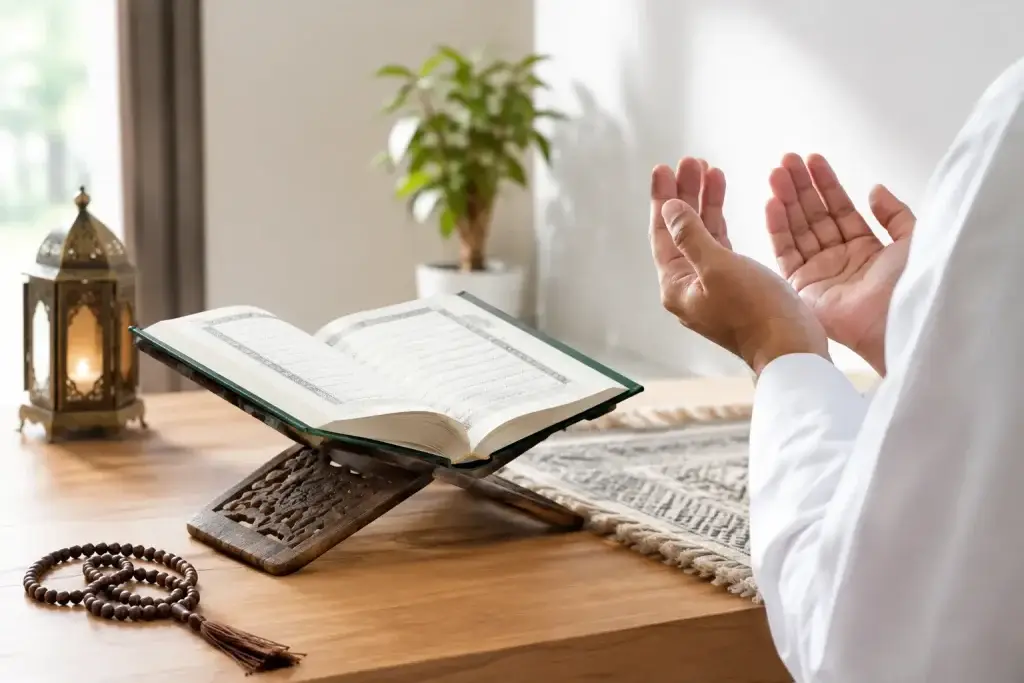
A family facing recurring distress does not need vague reassurance or a catalogue of frightening diagnoses. They need a sound response: turn to Allah, recite His Book with understanding and consistency, assess practical realities, and seek appropriate professional care. Quran healing verses belong at the centre of this response, not as a superstition or a mechanical formula, but as revealed speech through which Allah grants guidance, mercy, protection and, by His permission, healing.
The Qur’an states: “We send down in the Qur’an that which is healing and mercy for the believers” (17:82). It also describes the Qur’an as “a healing for what is in the breasts” (10:57). These verses establish a theological foundation. They do not authorise careless certainty about the cause of every symptom, nor do they remove the need for medical investigation. Rather, they establish that the believer has access to a divinely revealed means of healing that should be approached with yaqeen, correct adab and disciplined practice.
What Quran Healing Verses Mean in Ruqyah
In ruqyah, the Qur’an is recited as a means of seeking Allah’s protection, relief and cure. The reciter is not the source of healing. Water, oil, a treatment environment or any structured method are not independently effective either. Ash-Shafi is Allah alone. This distinction protects ruqyah from both empty ritual and exaggerated claims.
The Prophetic principle is clear: ruqyah is permissible where it contains no shirk. This provides a firm theological boundary. Within that boundary, there remains a difference between what is explicitly established in revelation, what scholars have accepted through general evidence, what experienced practitioners observe, and what remains a developing treatment hypothesis. Serious ruqyah work does not collapse these categories.
A person may recite for physical pain, anxiety, nightmares, family strain, persistent fear, suspected evil eye, suspected sihr, or symptoms that have not yet received a satisfactory explanation. Yet suspicion is not diagnosis. Similar symptoms may arise from trauma, neurological illness, hormonal disruption, sleep deprivation, depression, medication effects or ordinary life pressures. A responsible programme therefore treats Qur’anic recitation as spiritually central while encouraging medical and psychological assessment where it is warranted.
Core Quran Healing Verses and Surahs
There is no single short passage that makes the rest of the Qur’an irrelevant. The entire Qur’an is blessed, and the strongest approach combines established texts with consistent worship, du’a and personal reform. Certain passages, however, have a particularly clear place in daily protection and ruqyah practice.
Al-Fatihah
Surah Al-Fatihah is foundational. Its role in ruqyah is supported by the well-known report of the Companion who recited it for a man harmed by a sting, after which he recovered by Allah’s permission. The Prophet ﷺ approved this recitation. Al-Fatihah gathers praise of Allah, worship, dependence, a request for guidance and recognition of His mercy. It should never be reduced to a hurried chant.
Recite it with presence. Ask Allah specifically for shifa, clarity and protection. For self-ruqyah, recite and blow lightly into your hands, then wipe over the body where possible. The act is simple, but regularity matters more than drama.
Ayat al-Kursi
Ayat al-Kursi, Qur’an 2:255, establishes Allah’s absolute life, knowledge, authority and protection. It is especially relevant in a protection routine because of the authentic prophetic teaching concerning its recitation before sleep. Its force lies not in a technique detached from faith, but in what it teaches the heart: no created force escapes Allah’s knowledge or sovereignty.
For households, reciting it after the obligatory prayers and before sleep creates a stable pattern of remembrance. Parents can teach it gradually to children without turning bedtime into an anxious ritual.
Al-Ikhlas, Al-Falaq and An-Nas
The final three surahs are among the clearest Qur’anic foundations for protection. The Prophet ﷺ recited them, blew into his hands and wiped his body before sleep. Al-Ikhlas renews tawhid. Al-Falaq seeks refuge from created harms, envy and harmful practices. An-Nas seeks refuge with Allah from hidden whispering and inner disturbance.
Their sequence is instructive. Sound protection begins with knowing Allah, then seeking refuge from external harm, then seeking refuge from internal and unseen forms of harm. Recite them morning and evening, before sleep, and during periods of increased distress. Consistency is more valuable than repeatedly changing routines in search of an instant result.
Verses on Healing, Musa and the Invalidity of Falsehood
The Qur’an contains further passages often used in ruqyah, including the verses of healing in 9:14, 10:57, 16:69, 17:82, 20:105 and 26:80. The passages concerning Musa عليه السلام and the defeat of falsehood in 7:117-122, 10:81-82 and 20:68-70 are also widely recited in treatment contexts involving concerns about sihr.
Their use should be explained carefully. These passages are Qur’an and therefore carry blessing and guidance. Their repeated use by practitioners may also arise from scholarly tradition and clinical observation. But an individual reaction during recitation does not establish, by itself, that sihr or possession is present. It may be spiritually meaningful, emotionally charged, physically triggered or inconclusive. A trained practitioner records the pattern, considers alternatives and avoids turning one response into a definitive verdict.
A Practical Self-Ruqyah Routine
A sustainable routine is better than an exhausting schedule abandoned after three days. Begin with wudu where possible, pray the obligatory prayers on time, and set aside a calm period after Fajr or before sleep. Recite Al-Fatihah, Ayat al-Kursi, Al-Ikhlas, Al-Falaq and An-Nas with attention to meaning. Then make direct du’a for yourself and your household.
You may recite over yourself, your children, drinking water or olive oil for external use. These are means, not guarantees. Avoid assigning a mystical certainty to a particular number, sensation or object where no clear evidence establishes it. If a practitioner recommends a structured schedule, ask what is directly grounded in Qur’an and Sunnah, what is a practical arrangement, and what is based on practitioner experience. A trustworthy answer will distinguish these levels rather than blur them.
Keep a written record if symptoms are persistent. Note sleep, pain, mood, medication changes, stressors, medical appointments and responses to ruqyah. This is not a substitute for revelation; it is disciplined observation. It helps prevent the common error of attributing every fluctuation to one cause.
When Ruqyah Needs Wider Support
Ruqyah should not become a reason to delay urgent help. Severe pain, fainting, suicidal thoughts, psychosis, significant weight loss, seizures, self-harm, safeguarding concerns or sudden behavioural changes require prompt medical or mental-health assessment. Seeking treatment is part of tawakkul, not a rival to it.
Likewise, spiritual treatment may be appropriate alongside counselling, trauma-informed therapy, medication, sleep support or specialist investigation. Human beings are not simple. A believer may need Qur’anic healing, repentance, family support, clinical care and lifestyle change at the same time. The existence of one dimension does not cancel the others.
For advanced cases, competent support matters. A practitioner should be able to recite correctly, maintain boundaries, communicate without sensationalism, avoid unsupported diagnosis, and recognise when referral is necessary. International Academy of Ruqyah approaches this work as a structured capability: Qur’an-and-Sunnah grounding, careful assessment, practitioner discipline and ongoing inquiry rather than theatrical certainty.
The strongest starting point is not fear of what may be wrong. It is a return to what is certain: Allah hears, the Qur’an is truth, healing belongs to Him, and a steady practice of recitation, du’a, worship and responsible care can restore spiritual direction even before every question has been answered.