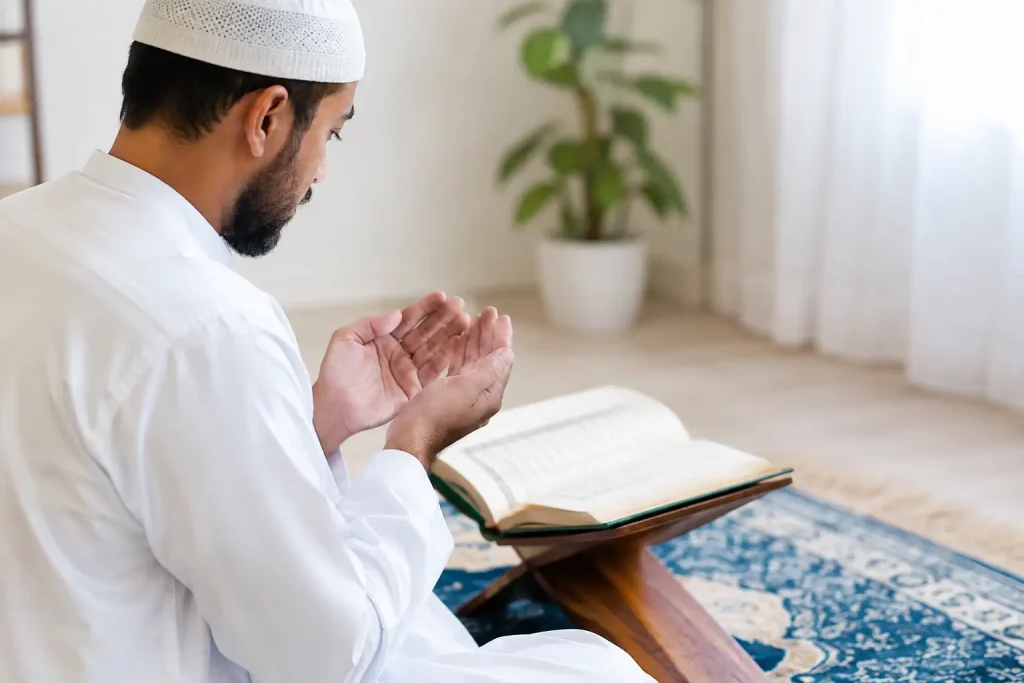
A person may know the well-known verses of ruqyah and still feel uncertain when the moment comes to recite them over themselves, a child, or an unwell family member. Learning how to recite healing verses is not primarily about producing a dramatic response. It is about turning to Allah with correct belief, clear Qur’anic recitation, sincere supplication, and a disciplined approach that does not neglect medical care or exaggerate what cannot be established.
The Qur’an describes itself as healing and mercy for the believers. Healing belongs to Allah alone, while the reciter takes a means that Allah has legislated. This distinction protects ruqyah from becoming mechanical. The verses do not operate independently of Allah’s will, and neither a practitioner nor a family member can promise a particular outcome.
Begin with the foundations of Qur’anic healing
Ruqyah is permitted when it is free from shirk and contains sound, intelligible words. The Prophetic practice establishes recitation of Qur’an and authentic supplications as means of protection and treatment. Al-Fatihah, al-Mu’awwidhatayn – Surah al-Falaq and Surah al-Nas – and other Qur’anic passages were recited for healing and protection.
This foundation matters because methods can become confused with the source of healing. The source is Allah. Qur’anic recitation, du’a, blowing lightly after recitation, and using lawful physical means are all secondary means. A Muslim should therefore avoid treating a repeated formula, a particular number, or an emotional reaction as proof that healing has occurred or that a specific spiritual diagnosis has been confirmed.
Spiritual distress may be relevant in some cases, but persistent pain, low mood, panic, sleep disturbance, seizures, digestive symptoms, or behavioural changes can also have medical, psychological, relational, and environmental dimensions. These possibilities can overlap. Responsible ruqyah does not require a person to choose between Qur’anic treatment and appropriate clinical assessment.
Prepare before you recite healing verses
The reciter does not need a special title to perform ruqyah for themselves or their household. Self-ruqyah is a valuable starting point because it cultivates reliance on Allah and gives families a practical protective routine.
Where possible, make wudu, choose a clean and calm place, and face the qiblah if convenient. These are helpful manners, not conditions without which ruqyah fails. More essential is the inward preparation: renew tawhid, repent from known sins, ask Allah for forgiveness, and set a specific intention. You may intend healing, protection, relief from fear, strength during illness, or wellbeing for a child.
Recite with attentiveness rather than haste. Correct tajwid is worth learning and improves the quality of recitation, but a person should not delay turning to Allah because their pronunciation is still developing. Read what you know accurately, use a mushaf if needed, and continue learning.
A clear method for reciting healing verses
A structured session can be brief and consistent. Begin by praising Allah and sending salah upon the Prophet Muhammad, peace and blessings be upon him. Then ask Allah directly for healing and protection. Recite in Arabic where you can, while understanding the meaning as far as possible.
A sound home method is to recite al-Fatihah, Ayat al-Kursi, the closing verses of Surah al-Baqarah, al-Ikhlas, al-Falaq, and al-Nas. You may then add verses commonly recited in relation to sihr, harm, healing, or Allah’s power, including relevant passages from Surah al-A’raf, Yunus, Taha, al-Isra, al-Anbiya and Fussilat.
These passages should not be treated as an inflexible checklist. The Qur’an as a whole is blessed speech. A person with limited memorisation can begin with al-Fatihah and the three closing surahs, then build gradually. What matters is consistency, presence of heart, and reliance on Allah rather than quantity alone.
After recitation, blow lightly and dryly into your hands, then wipe them over the face, head, chest, and body as far as you can reach. This is grounded in the reported Prophetic practice with the protective surahs. You may also recite directly over the area of pain, placing the hand there when appropriate, while observing modesty and personal boundaries.
If reciting for another person, obtain their consent wherever possible. Keep the setting dignified and avoid unnecessary physical contact, especially between unrelated men and women. A parent may recite over a child, and spouses or close family members can support one another with care and privacy.
Use direct prophetic supplications
Qur’anic verses can be accompanied by authentic supplications for healing. Among the most comprehensive is: “Allahumma Rabban-nas, adhhib il-ba’s, ishfi anta al-Shafi, la shifa’a illa shifa’uk, shifa’an la yughadiru saqama.” Its meaning is: O Allah, Lord of mankind, remove the harm and cure, for You are the Healer. There is no cure except Your cure, a cure that leaves no illness behind.
Another reported supplication begins: “Bismillahi arqik, min kulli shay’in yu’dhik.” Learn the Arabic from a reliable teacher or verified source, and understand what you are saying. The purpose is not to collect impressive formulas. It is to ask Allah with words rooted in revelation.
Reciting over water or oil: distinguish evidence and method
Many households recite Qur’an over water to drink or use externally, and some use olive oil after recitation. Such practices are used by many raqis as a practical treatment method. The Qur’anic principle of ruqyah is clear; the detailed application of reciting over a lawful substance involves scholarly discussion and practitioner experience.
It should therefore be described with precision. It is not a guaranteed treatment, nor does the water possess independent power. If used, keep it simple: recite Qur’an and du’a over clean drinking water, blow lightly after recitation, and drink it as a permissible means while asking Allah for benefit. Do not use unsafe substances, abandon prescribed medication, or turn a method into a test of faith.
This distinction is particularly important when exploring wider ruqyah methodologies. A method may be an observation, an inference, or a working hypothesis rather than an established Sunnah. Unfamiliarity alone does not prove theological prohibition, but neither does a compelling story establish effectiveness or religious authority. Serious practice requires both openness and restraint.
Set a routine without turning it into ritual pressure
For ongoing wellbeing, a short daily programme is usually more sustainable than an exhausting session performed once in crisis. Recite the morning and evening adhkar, maintain the five prayers, read a portion of Qur’an, and perform self-ruqyah before sleep. The reported night practice of reciting al-Ikhlas, al-Falaq and al-Nas into the hands and wiping the body is especially accessible for individuals and families.
For an acute concern, increase recitation according to capacity. Some people benefit from a focused period after Fajr or before sleep, when interruptions are fewer. Others need a family routine of ten minutes with children. There is no single duration that proves seriousness. A sustainable routine maintained with faith is stronger than an unsustainable programme driven by anxiety.
Keep brief notes if symptoms are persistent: sleep patterns, pain levels, mood, medication changes, stressful events, and the response to recitation. This is not to force every experience into a spiritual explanation. It helps identify patterns, supports communication with healthcare professionals, and prevents vague impressions from becoming premature conclusions.
Know when to seek further help
Seek urgent medical care for symptoms such as chest pain, severe breathing difficulty, fainting, sudden confusion, suicidal thoughts, serious injury, or signs of a stroke. Continue with medical professionals for diagnosed conditions and treatment-resistant symptoms alike. Ruqyah can sit alongside medical and psychological support; it should not be used to shame someone for needing either.
If concerns are prolonged or complex, structured guidance from a trained, ethical raqi may help. Look for sound creed, clear boundaries, respect for confidentiality, avoidance of inflated claims, and willingness to recognise uncertainty. A responsible practitioner does not diagnose sihr, evil eye, or al-mass from a single reaction, dream, or symptom.
International Academy of Ruqyah teaches ruqyah as a practical Islamic capability: grounded in Qur’an and Sunnah, strengthened by disciplined observation, and applied without reducing every hardship to one explanation.
Your first recitation does not need to be perfect or elaborate. Begin with al-Fatihah, ask Allah with sincerity, maintain your prayers, and return to the Qur’an consistently. Healing may come as relief, resilience, clarity, treatment access, protection from further harm, or a change known only to Allah. The servant’s task is to take lawful means with conviction and leave the result to the One who heals.