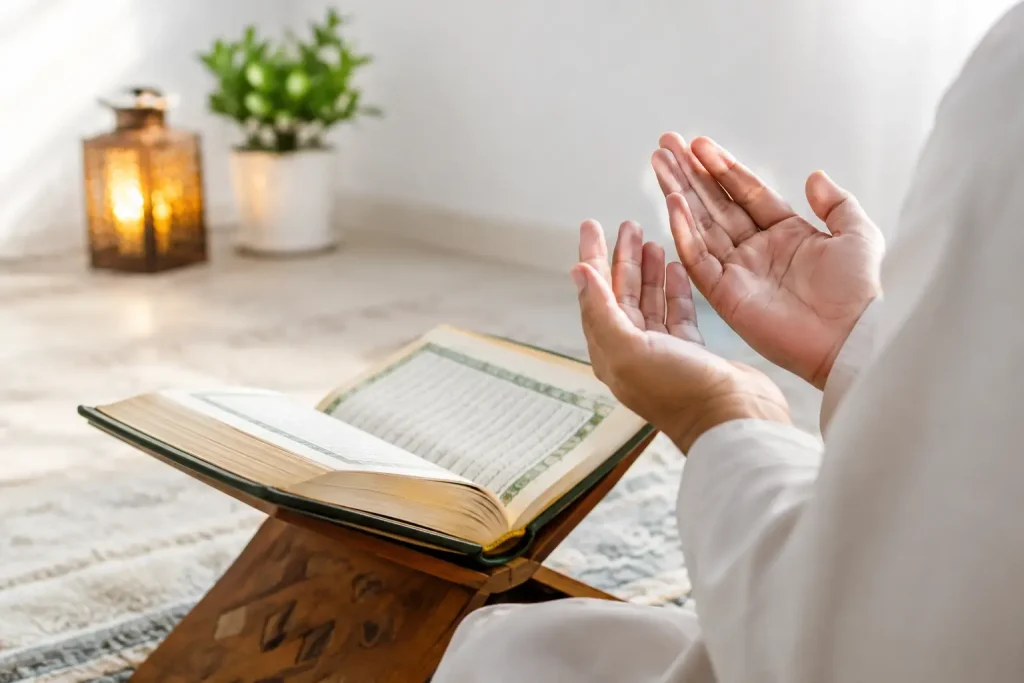
A person may know many healing verses yet feel no closer to a coherent ruqyah practice. The issue is often not a shortage of Qur’an, but a shortage of method: clear intention, correct belief, regular application, careful observation and appropriate use of medical care. Healing verses are not spiritual slogans. They are Qur’anic speech, recited in worship of Allah and used within a disciplined programme of ruqyah.
What Are Healing Verses?
The expression healing verses is commonly used for Qur’anic passages recited when seeking relief from physical pain, emotional distress or suspected spiritual harm. The Qur’an itself describes revelation as healing. Allah says that the Qur’an is “a healing for what is in the breasts” and describes it as healing and mercy for the believers.
This establishes a principle of great importance: the Qur’an is not merely a source of information or recitation for special occasions. It has a lived relationship with the believer’s heart, conduct, protection and wellbeing. Yet the word shifa’ should not be reduced to a mechanical promise that every recitation will produce an immediate, visible outcome. Allah is Ash-Shafi, the One who grants healing. The reciter uses the means that Allah has legislated, while the outcome, timing and form of relief remain with Him.
For ruqyah, the strongest foundation is clear: Qur’anic recitation, authentic supplications and reliance upon Allah. This is distinct from making claims about a person’s condition without sufficient evidence, or treating every persistent symptom as proof of sihr, ‘ayn or al-mass. Spiritual assessment requires seriousness, but seriousness is not the same as certainty without proof.
Core Healing Verses in Qur’anic Ruqyah
There is no authentic requirement to restrict ruqyah to one fixed list. The whole Qur’an is blessed, and any Qur’anic passage may be recited as ruqyah. However, certain chapters and verses have a particularly established place in Prophetic practice or in the inherited practice of ruqyah because of their meanings of tawhid, protection, mercy and the nullification of falsehood.
Al-Fatihah: The Foundation of Ruqyah
Surah Al-Fatihah occupies a central place in healing work. In the well-known hadith of the Companion who recited it over a man harmed by a sting, the Prophet ﷺ approved its use and asked, “How did you know that it was a ruqyah?” Its position is not accidental. Al-Fatihah gathers praise of Allah, servitude, dependence, a request for guidance and recognition of His lordship.
It should not be treated as a hurried opening before the “real” verses begin. For a patient or household building a daily practice, repeated, attentive recitation of Al-Fatihah may be more transformative than an exhausting routine performed without presence of heart.
Ayat al-Kursi and the Mu’awwidhat
Ayat al-Kursi establishes Allah’s absolute life, knowledge, authority and protection. Surah Al-Ikhlas reinforces pure tawhid, while Surah Al-Falaq and Surah An-Nas contain direct refuge-seeking from recognised forms of harm. These final two surahs were used by the Prophet ﷺ in seeking protection, including during illness.
A practical home routine can therefore include Al-Fatihah, Ayat al-Kursi, Al-Ikhlas, Al-Falaq and An-Nas, recited over oneself, children or water. The point is not to turn a set number into an unproven law. Consistency matters, but the worshipper should avoid believing that a chosen count independently produces an effect. Allah creates benefit through the means He wills.
Verses Concerning Musa and the Magicians
Verses from Surah Al-A’raf, Yunus and Taha narrating Musa’s encounter with the magicians are frequently used in ruqyah for suspected sihr. Their relevance lies in the Qur’anic declaration that Allah invalidates corrupt work and establishes truth by His words.
Their use is a recognised practitioner application, not a licence to diagnose sihr merely because someone has fatigue, family conflict, nightmares or a difficult medical history. Such experiences can have many explanations. Where there is concern, a qualified clinician’s assessment and thoughtful spiritual support can proceed together rather than competing for control of the case.
Recitation Is Not a Technique Detached From Belief
The effectiveness of ruqyah cannot be understood as sound waves, Arabic pronunciation or a private formula alone. Recitation is connected to iman, tawakkul, repentance, du’a, lawful conduct and the servant’s relationship with Allah. This does not mean a distressed person is to blame for their suffering. It means ruqyah is strongest when it is part of a wider return to Allah rather than a service consumed in isolation.
Begin with wudu where possible, face the qiblah if convenient, and make a clear intention to seek Allah’s healing and protection. Recite audibly enough to hear yourself, with measured pronunciation and attention to meaning. Blow lightly into the hands after recitation and wipe over the body, following the established Prophetic practice. Water may also be recited over and used for drinking or washing, provided the practice remains free from shirk, impurity and invented theological claims.
The person receiving ruqyah should not become passive. Self-ruqyah builds capability. A parent can learn to recite over a child; a spouse can support a spouse; an individual can establish a daily protection routine. A practitioner may guide the process, but dependence belongs to Allah, not to the practitioner, their voice, their reputation or their method.
A Structured Routine for Healing and Protection
For many households, an uncomplicated routine maintained daily is more beneficial than occasional, intense sessions. Morning and evening adhkar should form the protective framework. Add self-ruqyah at a consistent time, particularly before sleep or after Fajr, and maintain the obligatory prayers as the centre of the programme.
When symptoms are acute, increase recitation without panic. Keep brief notes on sleep, pain, mood, medication, stress, life events and responses to treatment. This is not an attempt to reduce spiritual experience to a spreadsheet. It is disciplined observation. Patterns may assist a practitioner, but they remain observations until stronger evidence justifies a conclusion.
Families should also review ordinary contributors to distress. Sleep deprivation, trauma, grief, nutritional deficiency, chronic pain, medication effects, anxiety and relationship strain can intensify suffering and may require professional support. Seeking a GP, specialist or mental health professional does not weaken tawakkul. It is part of taking lawful means.
Where Advanced Ruqyah Requires Care
Some practitioners explore additional treatment frameworks, including structured uses of water, environmental changes, sensory interventions or other Higher Ruqyah methodologies. Such approaches require careful distinction. A practitioner observation is not automatically an Islamic proof. A promising case outcome is not yet a universal treatment rule. A method’s unfamiliarity, on the other hand, does not by itself establish prohibition.
The governing questions are theological and evidential: does the method contain shirk, invoke other than Allah, claim hidden knowledge, contradict clear Islamic principles or impose certainty where none exists? If not, its status may require further scholarly and practical examination rather than reflexive acceptance or rejection. Responsible development demands case documentation, peer scrutiny, clear boundaries and honesty about uncertainty.
This is why serious ruqyah training matters. The International Academy of Ruqyah approaches practitioner development as more than memorising a list of verses. Competent practice requires Qur’anic grounding, adab, safeguarding, differential thinking, case structure and the ability to say, “This may be relevant, but it is not established.”
When to Seek Urgent Medical Help
Ruqyah should never delay urgent treatment. Severe chest pain, difficulty breathing, seizures, loss of consciousness, suicidal thoughts, psychosis, sudden neurological symptoms, serious dehydration or danger to oneself or others require immediate medical attention. Continue du’a and Qur’an, but act promptly through emergency services and qualified healthcare professionals.
The believer is not forced to choose between revelation and responsible care. Healing verses direct the heart towards Allah; medicine investigates bodily and psychological means; careful ruqyah considers spiritual possibilities without pretending to possess certainty over the unseen.
Make the Qur’an a daily companion before crisis forces the question. Recite with understanding, ask Allah with humility, take the means available to you, and allow disciplined practice – rather than fear or speculation – to shape your path towards healing.